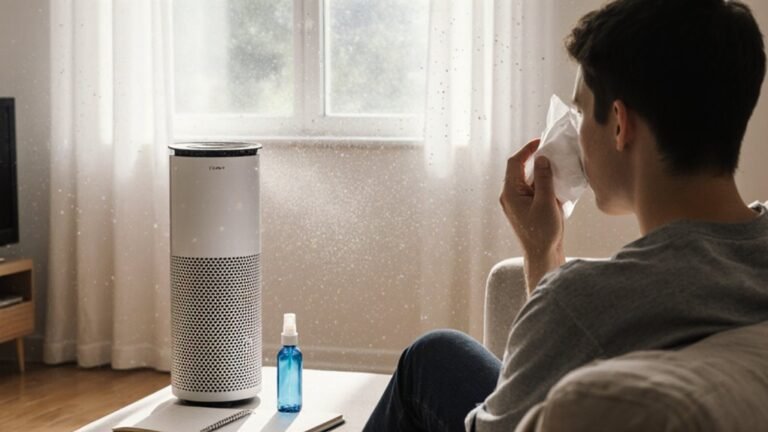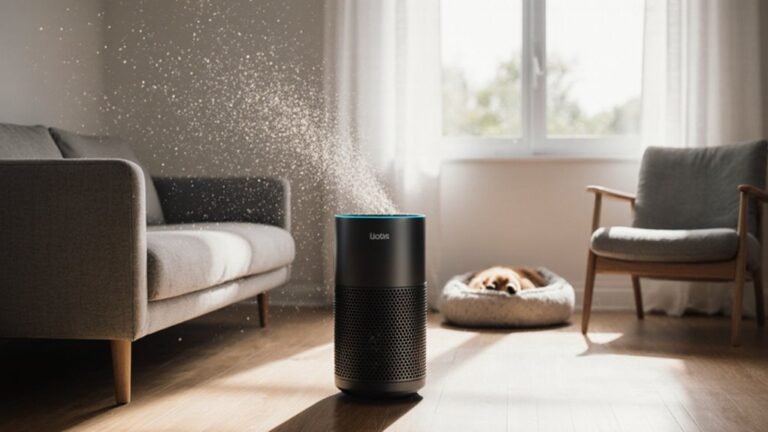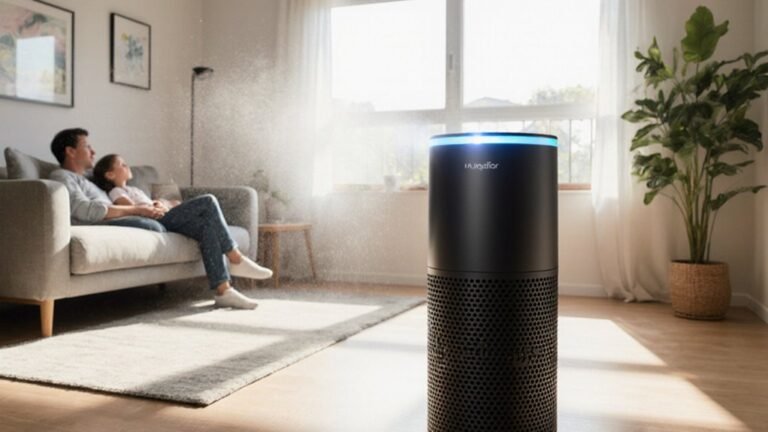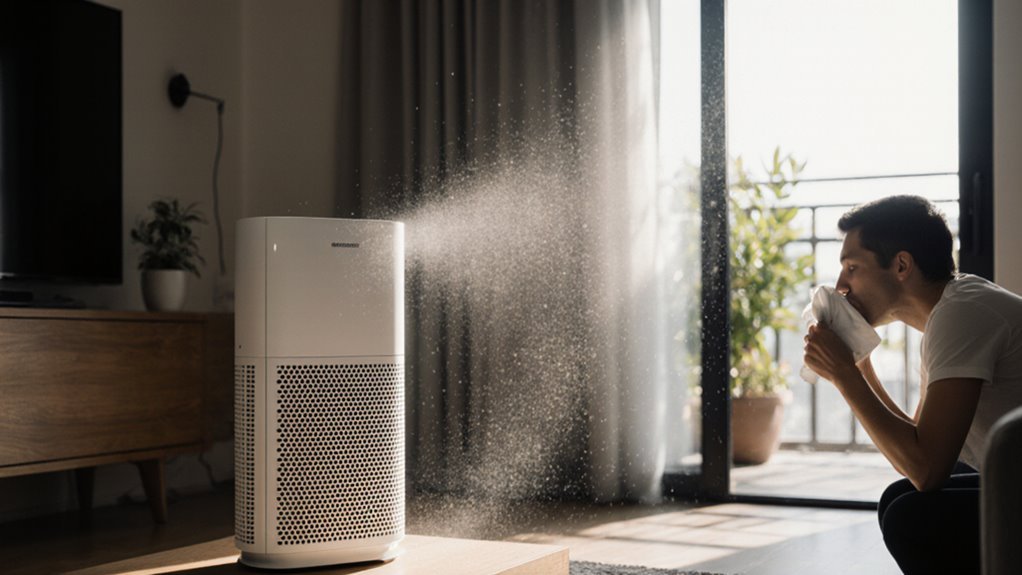

A true HEPA air purifier removes pollen, pet dander, dust-mite particles, and many mold spores from indoor air. Activated carbon filters reduce volatile odors and some gases. Filter size, CADR rating, and correct placement determine how effectively the device reduces allergen levels. Regular filter replacement and running the purifier for several hours daily keeps performance consistent. Small choices about unit capacity and maintenance change how much relief the purifier delivers for allergy symptoms.
What Air Purifiers Do for Allergies
Air purifiers can be a real comfort whenever allergies make your home feel less like a safe place and more like a sneezing contest. You can breathe easier whenever a true HEPA unit traps 99.97% of tiny particles, and that steady cleanup can help your room feel calmer.
For one room, pick a CADR that matches about two-thirds of the square footage, so airflow behavior support enough air changes. Should you run a HEPA purifier in your bedroom, you might see less fine dust in the air and need fewer meds.
Whole-house MERV 11 to 13 filters can also help, as long as you protect filter lifespan and replace them about every three months. Skip ionic models, since they might spread particles onto surfaces and irritate your airways.
Which Allergens Air Purifiers Can Remove
You can remove many common indoor allergens with the right air purifier, especially pollen, pet dander, and some mold particles. A true HEPA filter traps tiny airborne bits very well, while activated carbon can help with gases and odors that make your symptoms worse.
Still, the purifier has to match your room size, or it won’t clear the air as fast as you need.
Common Indoor Allergens
Inside your home, the main allergy triggers often float right through the air, and that’s where a good purifier can help. You’ll notice more trouble during seasonal patterns, especially whenever windows stay shut and humidity control gets tricky.
- Pollen can drift inside and stay in the air.
- Pet dander can keep sneaking around after playtime.
- Dust mite bits can rise from bedding and rugs.
- Fungal spores can move through damp rooms.
- Smoke and fine particles can also irritate you.
A true HEPA purifier can catch at least 99.97% of tiny 0.3 micron particles, so it helps clear these common irritants. Should you choose one with carbon, it can also cut odors and some gases that bother your nose and throat. That makes your space feel calmer, cleaner, and more like home.
HEPA Removal Limits
Even a strong HEPA purifier has clear limits, and that matters any time you’re trying to breathe easier at home. You can trust it to trap 99.97% of particles at 0.3 microns and nearby sizes, so it helps with many airborne allergens. It also catches some dust mite waste and smaller ultrafine particles, but it won’t grab live mites because they don’t float around.
That’s where filter limitations show up. For smells, fumes, and many VOCs, you need more than HEPA alone because gas capture is weak without activated carbon or similar media. You’ll get the best results whenever the purifier fits your room and you change filters on time, since poor sizing or stale filters can leave you breathing yesterday’s problems.
Pollen, Dander, and Mold
Whenever allergies keep making home feel less restful, a true HEPA air purifier can take a real load off your shoulders through removing many of the tiny particles that trigger symptoms.
You’ll notice the biggest help whenever spring blooms send pollen inside, or whenever outdoor tracking brings pet dander and dust on clothes.
- HEPA traps most pollen grains
- It also captures pet dander
- It removes airborne mold spores
- It helps with dust clumps carrying allergens
- Pair it with the right CADR for your room
Activated carbon won’t catch these particles, but it can soften pet or mold odors.
For mold, though, you still need to dry and clean the source.
Skip ionizing models whenever you want cleaner air without extra ozone.
How the Allergy Study Was Designed
You can see that this study used a careful multicenter, randomized, double-blind, placebo-controlled design, so the results weren’t left to chance.
It followed 44 adults with house dust mite allergy for 6 weeks in late autumn and at the start of winter, while indoor heating stayed off.
You’ll also notice that each home got two continuously running purifiers, while the team kept the blinding tight and tracked symptoms, medicine use, and indoor particle levels the whole time.
Study Design Overview
Because this study wanted a clear, fair trial, the researchers used a randomized, double-blind, placebo-controlled design across two South Korean hospitals. You can trust the trial timing, because it stayed fixed for 6 weeks in late autumn and foremost winter. That setup helped the team keep placebo integrity strong and fair for everyone involved.
- Two centers joined in Seoul and Gwangju.
- Forty-four adults were split 1:1.
- Active and mock purifiers looked the same.
- Devices ran all day and night.
- Remote sensors tracked purifier use and room particles.
You also got steady check-ins at baseline, 3 weeks, and 6 weeks, so the study could track change without extra confusion. The team measured symptoms, medicine use, quality of life, and room dust levels with careful tools, which gave the trial a calm, organized rhythm.
Participants And Methods
To trial air purifiers in a fair and careful way, the researchers ran a randomized, double-blind, placebo-controlled multicenter trial at Yonsei University and Chonnam National University, and they enrolled 44 adults with persistent moderate-to-severe allergic rhinitis caused through house dust mites.
You’d see clear participant demographics: 22 people got active units and 22 got mock units. They confirmed sensitization with skin-prick assays or serum IgE, and they excluded other rhinitis causes, pollen allergy, smoke exposure, and planned moves.
Next, they protected randomization integrity by using third-party computer assignment and concealed allocation.
For 6 weeks in late autumn, you used two in-room purifiers, one in the main room and one in the bedroom.
Clinic visits at baseline, 3 weeks, and 6 weeks tracked symptoms, medication, QoL, VAS, and indoor PM2.5/PM10.
What the Allergy Study Found
The allergy study gave a clear, hopeful signal: running two HEPA air purifiers in the bedroom for 6 weeks helped adults with moderate to severe house dust mite allergic rhinitis use less medication, even though their day-to-day symptoms didn’t change much on paper.
- You saw better medication scores.
- You kept your usual rhinitis medicines.
- You tracked longitudinal exposure with sensors.
- You showed stronger medication adherence.
- You noticed cleaner bedroom and residential-room air.
This matters because your bedroom air started out dirtier than the residential room and outdoors, then PM2.5 fell as much as 51.8% with active purifier use.
Still, symptom scores, visual analog scales, and quality-of-life reports stayed similar between groups. So, while you mightn’t feel an instant shift, the study suggests cleaner air can support your routine in a steady, practical way.
How to Pick the Right HEPA Air Purifier
To pick the right HEPA air purifier, you’ll want to match the unit to your room size initially, because a purifier that’s too small won’t clean the air well enough.
Look for a true HEPA filter and a CADR rating that fits your space, so it can handle pollen, pet dander, and dust with confidence.
In case odors or smoke bother you too, check for activated carbon, quiet operation, and clear filter replacement costs so you’re not stuck guessing later.
Room Size And CADR
A HEPA purifier only helps provided it fits your room, so size and CADR matter more than fancy extras. You want a unit that matches your space, so you feel the air getting cleaner, not just louder. Consider about portable maintenance and noise levels too, because a purifier should fit your life, not fight it.
- Use CADR, in CFM, for room area.
- Aim for at least two-thirds of the room’s square footage.
- Target 4.8 ACH for strong allergen removal.
- Check pollen CADR initially for seasonal allergies.
- For bigger rooms, use multiple units or better HVAC filters.
If your bedroom runs dusty or feels heavy, size up for that room, not a tiny bedside model. A well-matched purifier helps you breathe easier and feel at home.
HEPA Filters And Features
Now that you know room size and CADR matter, you can look at what’s inside the purifier and what it can actually do for your home. A true HEPA filter catches 99.97% of tiny particles, so it can calm pollen, pet dander, and dust-mite bits. In case smells bother your home team, add activated carbon for smoke and VOCs.
| Feature | Why it matters | What you feel |
|---|---|---|
| True HEPA | Traps allergens | Easier breathing |
| Carbon layer | Cuts odors | A fresher room |
| Low noise levels | Runs without stress | Better sleep |
Choose certified units with AHAM, Energy Star, and CARB labels, and skip ionizers. Check filter lifespan too, so you’re not stuck with surprise swaps. For whole-house help, use MERV 11 to 13 HVAC filters every three months.
Why CADR and Room Size Matter
Upon choosing an air purifier, CADR and room size work together, and getting that match right can make a big difference in how fast your air feels better.
- Check the pollen CADR initially for pollen and dust.
- Aim for CADR at least two-thirds of your room’s square footage.
- Bigger CADR means quicker cleaning and more air changes.
- Too small a unit could leave you waiting hours.
- Match coverage to your room, then pair it with ventilation strategies and seasonal maintenance.
If your room is 150 square feet, look for about 100 CADR or more. That gives you steadier relief and a setup that fits your space.
Once you size it well, you’re not guessing alone; you’re choosing with confidence, and your home can feel more like the calm place you need.
Why Ionizers and Ozone Are Risky
Should you’ve already matched CADR to your room, you could feel ready to pick any feature that sounds high-tech, but ionizers can bring an obscured problem with them. Many models use ozone chemistry, and that ozone can irritate your lungs. You might notice more coughing, chest tightness, or allergy flare-ups, especially should you have asthma.
Some ionic cleaners also just charge particles so they land on walls and furniture, where they can get stirred back up later. That means your air could still carry allergens when you need relief most.
Health experts warn against ozone-generating units in lived-in rooms because they can strain respiratory mechanisms and reduce lung function. Should you want steadier help, look for CARB or UL listed units with zero ozone claims and evidence from real filtration evaluations.
How HVAC Filters Help the Whole House
Your HVAC filter can do a lot more than catch dust bunnies and the odd mystery fluff drifting through the vents. Whenever you choose a MERV 11 to 13 filter, you improve filtration efficiency for the whole house, not just one room. That means you help trap fine particles like pollen, dander, and PM2.5 before they keep floating around your home.
- It cleans air through every supply vent.
- It supports shared comfort for your family.
- It works better than cheap fiberglass filters.
- It beats hard-to-clean permanent filters.
- It needs seasonal maintenance and schedule adherence.
Change it about every three months, or sooner assuming you have pets or lots of dust. That simple habit keeps airflow steady and helps your home feel calmer, cleaner, and easier to breathe in together.
Other Ways to Reduce Indoor Allergens
Beyond good filters, you can cut indoor allergens in a few practical ways that make a real difference day after day.
Start with humidity control: keep indoor relative humidity below 50%, ideally 30 to 50%, so dust mites and mold can’t thrive. Use a dehumidifier or air conditioning, not humidifiers.
Next, make seasonal cleaning part of your routine. Wash bedding, stuffed toys, and pet bedding weekly in hot water, or use allergen-proof encasings for mattresses and pillows.
At the door, leave shoes and pollen behind with a strong doormat. During peak pollen season, change clothes after being outside.
Also, vacuum with a sealed HEPA model whenever you can step out, and keep smoke out, groom pets outdoors, and scrub damp bathrooms and basements.
When Air Purifiers Help Most
Air purifiers help most while you place them where allergens build up and keep them running while exposure is highest. You’ll feel the biggest change in bedrooms and living areas, when pollen, pet dander, and dust can hang around. With portable placement, you can move a true HEPA unit to the room you use most and breathe easier there.
- Size the purifier to the room.
- Run it 24/7 during seasonal maintenance periods.
- Keep humidity below 50%.
- Use HEPA vacuuming with it.
- Choose carbon layers for odors, not ionizers.
If your home uses HVAC filtration, a MERV 11 to 13 filter can help across spaces, but change it often.
When you match the unit to the room and keep it on, you give your household a calmer, cleaner place to settle in.
Frequently Asked Questions
How Often Should I Replace My Purifier’s Filter?
You should replace your purifier’s filter every 6 to 12 months. Check your manual for the exact interval. Filter lifespan depends on use and air quality, so follow your maintenance schedule to keep your home feeling fresh and cared for.
Do Air Purifiers Remove Viruses From Indoor Air?
Yes, you can reduce airborne viruses with a HEPA purifier, and UV sterilization might help further. You will still need ventilation and hygiene, but together you could build a safer space where everyone feels cared for.
Can One Purifier Cover Multiple Rooms Effectively?
Not usually. You’ll likely need multiple units. If you evaluate the idea that one purifier can cover everything, you will find that multi room spaces, room airflow zoning, portable units, and open plan layouts usually need separate coverage.
Are Activated-Carbon Filters Necessary for Odor Control?
Yes, you’ll usually want activated carbon filters for odor control because carbon adsorption targets odor chemistry better than basic filters. You’ll feel more confident, and your space can smell fresher, helping you belong comfortably.
Should I Run My Air Purifier All Day or Only at Night?
You should run it all day if you can because continuous operation keeps the air cleaner and more consistent. If you need to balance comfort and energy costs, run it only at night; otherwise consider the energy tradeoffs and choose what fits your routine.