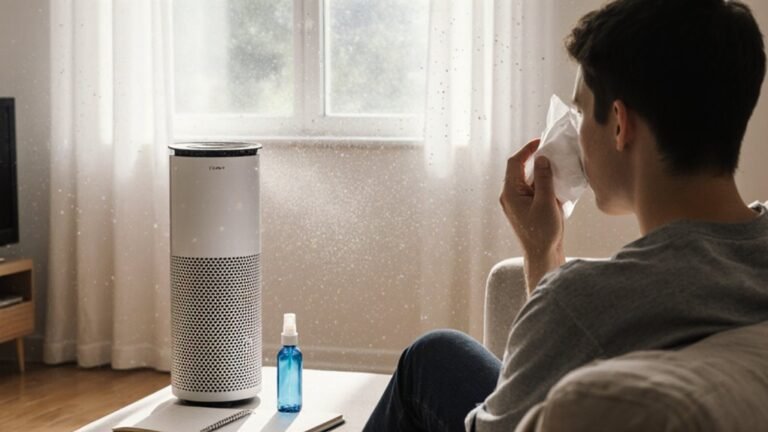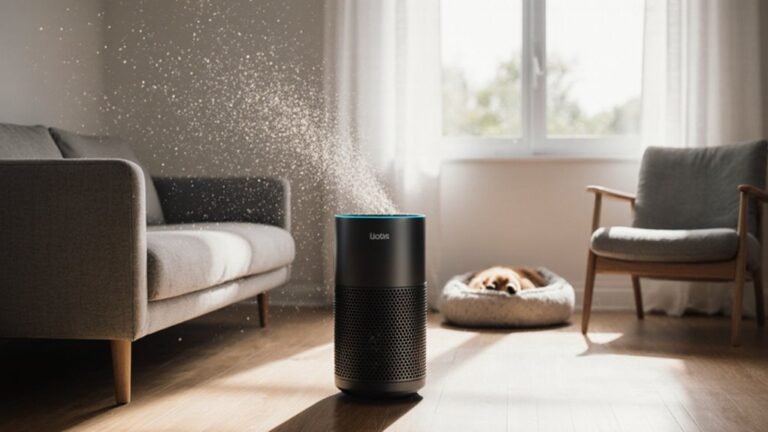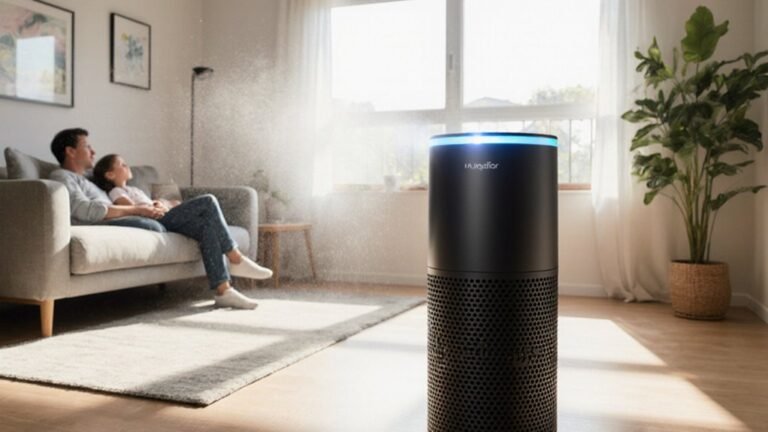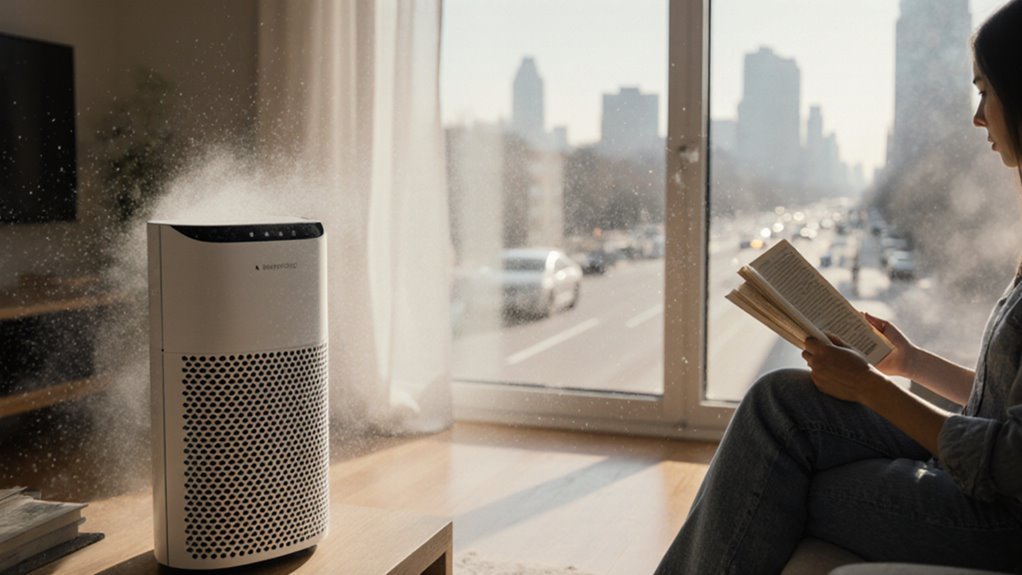

Air purifiers reduce indoor pollutants like dust, pollen, pet dander, smoke, and PM2.5 particles. HEPA filters capture tiny particles while activated carbon absorbs odors and some gases. Proper placement and correct unit size determine real-world performance. Regular filter replacement and adequate airflow keep units working effectively. Many users place units in corners or buy undersized models, reducing potential benefits.
Why Air Purifiers Matter
As soon as you bring the right air purifier into your home, it can make the air feel easier to breathe almost immediately.
You spend most of your day indoors, so the air around you shapes how you feel, sleep, and function. A well sized HEPA unit can capture 99.97% of tiny particles, which helps cut indoor dust, pollen, and pet dander. That matters because long term exposure to dirty air can wear you down.
Studies show indoor particle levels can drop around 30 to 50% with steady use. To get that benefit, keep it running, match it to your room, and replace filters on time. Consider it as one of the simplest behavioral interventions for a healthier home.
What Indoor Pollutants They Remove
You can count on most air purifiers to trap tiny particles like pollen, pet dander, mold spores, and PM2.5, which are often the biggest troublemakers in your home.
Should you choose a unit with the right filter, it can also help cut smoke and cooking particles, but standard HEPA filters won’t remove most gases or odors. For that, you’ll need activated carbon, and it’s good to bear in mind that no purifier fixes dampness, carbon monoxide, or the source of the problem.
Particle Removal Basics
HEPA filters do the heavy lifting for particle removal, and they can trap tiny airborne specks down to about 0.3 microns with at least 99.97% efficiency. Whenever you choose one with strong filter evaluation, you’re not guessing, you’re giving your space a better shot at cleaner air. These filters catch pollen, dust mite debris, pet dander, and much of smoke and PM2.5.
That matters because particle size changes where it lands in your body, from your upper airways to deeper lungs. So, you want a purifier with a high CADR and airflow patterns that move room air through the filter often. Run it steadily, and you can cut indoor PM2.5 by about half. For gases, though, you’ll need carbon, since HEPA alone won’t do that job.
Common Indoor Pollutants
Common indoor pollutants can feel sneaky, but once you know what each filter can and can’t catch, the image gets much clearer. You’re not alone should your home feels busy with tiny irritants.
Some cleaners help with particles, while others help with gases.
- HEPA can grab pollen, pet dander, dust mites, and many mold spores.
- High smoke-CADR units can lower fine smoke from cooking fumes and cigarettes.
- Carbon beds help with odors and VOCs from paint or cleaning sprays.
- Filtration won’t fix moisture mold, settled dust, or carbon monoxide.
Filter Types And Limits
Whenever indoor air starts to feel heavy, the right filter can make a real difference, but only provided it matches the pollutant you’re trying to catch.
HEPA filters are your go-to for tiny particles. They trap PM2.5, pollen, pet dander, mold spores, and many bacteria, so you can breathe easier at home. Yet they won’t affect gases or most VOCs.
For odors and smoke fumes, you need activated carbon or another sorbent filter. A thicker carbon bed usually gives better gas capture, though it needs more Filter maintenance and could shorten Filter longevity.
If your HVAC can handle it, MERV 13 or better can help with particles while the system operates. Just make sure it fits well. Skip ionizers and ozone devices, since they’re unreliable and can add risk.
How Pollution Affects Your Health
Pollution can feel invisible, but your body often notices it fast. Whenever you breathe fine particles, they travel deep into your lungs and stress your cardiopulmonary mechanisms. Some tiny particles can even enter your blood, where they trigger inflammation and strain your heart and vessels.
That’s why exposure can raise your risk of heart disease, stroke, and lung damage. It can also affect your neurological impacts, leaving you with headaches or that foggy, off-kilter feeling.
- Your eyes, nose, and throat could burn after a spike.
- You might cough more or wheeze during the day.
- Long exposure can worsen asthma or COPD.
- Household smoke and outdoor particles can both accumulate.
Why Indoor Air Can Be Worse
You spend most of your time indoors, so the air around you can collect pollution fast. Cooking, cleaning, smoking, and even building materials can add gases and tiny particles that hang in the room.
Whenever windows stay closed or ventilation is weak, those pollutants build up and can make indoor air worse than the air outside.
Indoor Sources Add Pollution
Since most people spend about 90% of their time indoors, it’s easy to forget that the air inside can be up to five times more polluted than the air outside. You breathe that mix at home, at school, and at work, so you deserve to know what adds to it.
- cooking emissions from gas or biomass can fill rooms fast
- heating and incense add fine particles and gases
- furniture, paint, and cleaners release VOCs in indoor chemistry
- dust mites, pet dander, and mould can linger in soft surfaces
Tobacco smoke and nearby industrial pollution can also drift in and raise PM2.5 and ultrafine particles. These tiny bits can reach deep into your lungs, which isn’t fair while you’re just trying to relax with your people.
Pollutants Build Up Indoors
The air inside can feel calm, but it often hides a busy mix of pollutants that keep building up. You spend most of your day indoors, so even small emissions can stack up fast. Cooking, cleaning, furniture, and building materials release particles, VOCs, formaldehyde, and allergens into your rooms.
Then occupant behavior, like smoking, burning incense, or running a gas stove, adds sharp spikes that linger in still air. Because HVAC filters only work while the system runs, pollution can rise between cycles. That’s why seasonal buildup can feel worse whenever windows stay shut.
Should moisture remain high, mould and dust mites also grow, adding more irritants. In a crowded home, you might notice the air getting heavier, and you’re not imagining it.
HEPA, Carbon, and Other Filters
HEPA filters give you one of the most reliable ways to clean the air in your home. Whenever you pick true HEPA, you help trap at least 99.97% of airborne particles, including pollen and pet dander, whenever the unit fits your room and runs steadily. That can feel like a real relief.
- Use CADR to match the purifier to your space.
- Choose carbon beds for odor targeting and VOCs.
- Check filter lifespan so you can stay ready.
- Ask whether MERV 13 HVAC filters fit your system.
Next, you can pair a HEPA unit with carbon filtration for both particles and smells. For gases, thick carbon works best. Skip ionizers and ozone generators; they can add risk without steady help. Whenever you choose well, you make your home feel more welcoming for everyone.
How Particle Size Changes Results
Particle size changes everything, and that’s why some pollutants feel harder to control than others. In aerosol behavior, bigger coarse particles usually drop out fast, while fine PM2.5 lingers and slips deeper into your lungs. That matters because deposition mechanisms change with size and speed.
| Size class | Airborne behavior | Main result |
|---|---|---|
| Coarse 2.5-10 μm | Falls sooner | Stays in nose and throat |
| Fine <2.5 μm | Stays suspended longer | Reaches alveoli |
| Ultrafine <0.1 μm | Moves like a tiny crowd | Can enter blood |
What Air Purifiers Catch
Once you start looking at what a purifier can actually grab, the image gets much clearer. You can trust HEPA to catch pollen, pet dander, dust mite bits, and many fine PM2.5 particles. That means your air can feel easier to breathe, and you’re not just hoping for the best.
- It can help cut indoor PM2.5 by about half provided you use it well.
- It can reduce ultrafine particles, though not every last one.
- It needs activated carbon to tackle VOCs and odors.
- It won’t fully remove gases like formaldehyde or carbon monoxide.
Where to Use One at Home
The best place for an air purifier at home is usually the room where you spend the most time, because that’s where it can help you the most.
Start with sleep placement in your bedroom, since you breathe there for hours and a HEPA unit can cut dust and allergy triggers while you rest.
Then move one to the living room whether that’s where your family gathers, especially in open spaces where smoke, pet dander, and dust drift around.
In the kitchen, run a purifier during and after cooking to ease short bursts of fine particles.
Should a child have asthma or allergies, a purifier in a bedroom or playroom can bring real comfort.
Watch noise levels too, so the unit feels like part of home, not a stranger.
How to Choose the Right Size
You can get the best results whenever you match the purifier’s CADR to your room size, because a unit that’s too small just can’t keep up.
For an 8-foot ceiling, a simple rule is about 1.3 times the room area in CADR, so a 300-square-foot room needs roughly 390 cfm.
In case your space is open or has a taller ceiling, you’ll want to size up or use more than one unit so the clean air keeps moving.
Room Size Matching
Matching the right air purifier to your room size can feel tricky, but it gets much easier once you use CADR as your guide. You’re not guessing alone here; you’re choosing a fit that helps your space breathe better.
- 100 ft²: about 130 cfm
- 200 ft²: about 195 cfm
- 300 ft²: about 260 cfm
- 400 ft²: about 325 cfm
- 500 ft²: about 390 cfm
Check the tobacco-smoke CADR, since it tracks fine particles well. Should your ceiling height be above 8 ft, raise the target. For an open plan strategy, add CADR or use more than one unit so you still hit 4 to 6 ACH.
In bedrooms, family rooms, or smoky spaces, size up with confidence. Should you rely on central HVAC, choose MERV-13 and run the fan enough.
Clean Air Delivery
Whenever you’re sizing a portable air cleaner, consider of CADR as the number that quietly does the hard work for you. You want a rating that fits your room, so aim for about 130 cfm for 100 square feet, 195 for 200, 260 for 300, 325 for 400, and 390 for 500, assuming an 8-foot ceiling.
Should your ceiling be taller, the space be open, or you share air across rooms, choose a stronger unit or two smaller ones. For PM2.5, look for a high tobacco-smoke CADR and HEPA filtration. Then ponder about fan noise and energy efficiency, because the best purifier is the one you’ll actually run. Higher speeds clean more air, and steady use keeps your space feeling safer and calmer.
What the Research Shows
Research gives us a fairly clear portrayal: whenever a portable HEPA air cleaner runs in the right room and runs long enough, it can cut indoor PM2.5 by about half, and that drop can bring small but real relief for people residing with asthma or heart concerns.
- Trials in low-income bedrooms show this pattern again and again.
- HEPA filters trap pollen, pet dander, dust, and smoke well.
- Longitudinal effectiveness matters whenever you want lasting exposure drops.
- These results also highlight exposure disparities that hit some homes harder.
You can also see promise from MERV 13 HVAC filters whenever your system moves air well. Still, filtration mostly targets particles. For gases, you’d need carbon media. Some newer devices sound fancy, but they don’t beat mechanical HEPA for safe, proven relief.
How to Use One Effectively
To get the most from an air purifier, start sizing it right for the room you actually use, since a unit that’s too small will work harder and help less.
Pick a model with a CADR that matches your space, and choose true HEPA filtration for fine particles like PM2.5 and wildfire smoke. Should smells or fumes bother you, add activated carbon.
For best placement timing, keep it in the room where you spend the most time, away from walls and clutter. Then let it run continuously, or use auto mode, so the air stays cleaner all day.
Higher fan speeds can increase air changes, though noise levels might rise a bit. Keep doors and windows closed during bad outdoor air, and follow filter care guidance so your purifier keeps pulling its weight.
Common Mistakes to Avoid
Even a good air purifier can miss the mark in case you use it the wrong way, and that can be frustrating whenever you’re trying to breathe easier at home. Watch for placement myths and maintenance myths that quietly cut performance.
- Don’t buy a unit that’s too small for your room.
- Don’t trust particle-only HEPA models for odors or smoke gases.
- Don’t switch it off often or leave it on low all day.
- Don’t skip filter changes or cleanings, and avoid ozone makers.
If your room is large, you might need a stronger CADR or more than one purifier. Also, choose activated carbon whenever you desire help with cooking fumes or household smells.
Whenever you steer clear of these common traps, you give your purifier a fair shot and make your space feel more like the calm, shared place you want it to be.
Is an Air Purifier Worth It?
Should you’re considering whether an air purifier is worth the money, the short answer is yes for many homes, especially should you deal with dust, allergies, smoke, or pet dander. It can make your space feel easier to breathe in, and that matters.
| Use case | What you notice | Value |
|---|---|---|
| Bedroom HEPA | Less PM2.5 | Strong |
| Allergies | Fewer triggers | Strong |
| Smoke | Cleaner air | Good |
| Pets | Less dander | Good |
| VOCs | Needs carbon | Limited |
For cost effectiveness, a good portable HEPA unit can cut particles fast, but you still need behavior change, like changing filters and keeping windows open whenever outdoor air is clean. HVAC filters help too, yet they only work whenever your system runs. So, should you want steady room-level help, an air purifier often earns its place.
Frequently Asked Questions
Is It Safe to Use an Air Purifier Every Day?
Yes, you can safely run an air purifier every day, and it will feel like your home’s own silent guardian. Keep up with filter maintenance, watch the noise level, and you will breathe easier together.