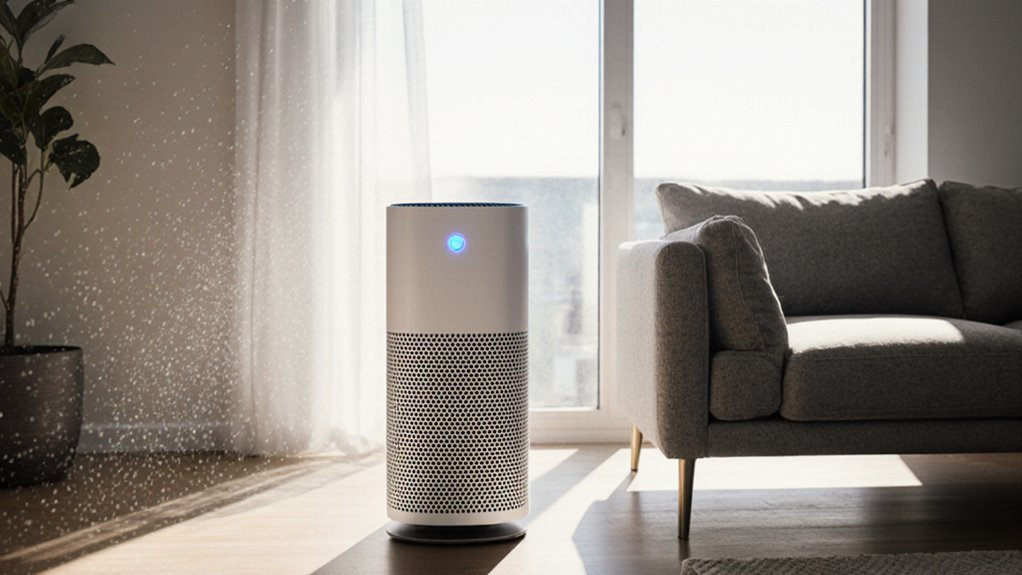

An air purifier can make a room feel noticeably fresher within 30 to 60 minutes. Actual cleanup time depends on room size, the purifier’s CADR (clean air delivery rate), air exchange rate, and pollutant load like smoke, dust, or pet dander. A larger or leakier room and a clogged filter extend cleaning time. Running the purifier at a higher fan speed and using the right-sized unit cuts time significantly. Next, learn which factors matter most and how to use them to speed up air cleaning.
How Long Does It Take an Air Purifier to Clean a Room?
A clean breath can feel close faster than you could suppose. You’ll usually notice cleaner air in a small room within 30 to 60 minutes, especially when the purifier fits the space well.
In a medium room, it might take 1 to 3 hours for you to feel a real shift. Your occupant behavior matters too, because opening doors, smoking, or cooking can slow progress.
Noise levels can also affect how long you keep it running, since a quieter setting could feel easier at night, while higher speed cleans faster. Should you want better results, keep the unit clear, close windows, and let it run steadily.
Then the room can feel like a calmer place for everyone there.
What Affects Air Purifier Cleaning Time?
What affects air purifier cleaning time is mostly how much air the unit has to work through and how hard it can push that air. In case you place it well, it can move cleaner air through the room faster, and a smart placement strategy helps it avoid blocked corners and crowded furniture.
You’ll also see slower results provided doors stay open, smoke keeps entering, or dust keeps building up.
Then filter maintenance matters too, because a dirty filter makes the unit work harder and cut its own power. Higher fan settings usually clean faster, while low settings feel gentler but take longer.
Why CADR and Room Size Matter Most
CADR tells you how much clean air your purifier can move, and that number matters because it sets the pace for cleaning your room.
Provided the room is too big for the CADR, you’ll wait longer for better air, even assuming the unit is running all day.
Whenever you match the purifier to the room size, you give yourself a much better shot at faster, steadier results.
CADR Basics
Ever wonder why one air purifier seems to work fast while another barely makes a dent? CADR tells you. It means Clean Air Delivery Rate, and it shows how much clean air the unit pushes each minute. Whenever you pair CADR with room size, you start to see real results. A higher number can feel like a strong breeze in a busy room, while a low one might just whisper. You’ll also notice filter efficiency and fan noise shape your daily comfort, because a quiet unit still has to move enough air.
- A small bedroom
- A family den
- Dust floating in sunlight
- A purifier humming nearby
Room Size Match
A purifier can sound powerful, but the room it serves decides how far that power really goes. Should your space be too big, clean air spreads thin, and you wait longer to feel at home again. Match CADR to room size, and you’ll notice steadier comfort with less guesswork.
| Room | CADR Need | Feel |
|---|---|---|
| Small bedroom | Medium | Quick relief |
| Sitting room | Higher | Steady flow |
| Open space | Very high | Shared calm |
Use placement strategy near the main source, not a concealed corner, so the purifier can mix air faster. In a bigger room, you might also face noise tradeoffs as higher fan speeds work harder. That’s the real fit exam: your purifier should suit your space, your pace, and the way you reside together.
How to Speed Up Air Purifier Cleaning
To speed up air purifier cleaning, start with the room itself, because the purifier can only work as fast as the air around it lets it. Close doors and windows, then clear space around the unit so air can move freely.
Good fan placement matters too: set the purifier where it can pull dirty air in and push clean air across the room, not into a wall. That often means the center or near the problem spot.
- A sealed bedroom with still curtains
- A purifier breathing freely beside the bed
- Dust drifting away from open vents
- A quiet room with fewer noise tradeoffs
Next, raise the fan during heavy smoke or dust, then lower it once the air looks cleaner. You’ll get faster cleanup and a calmer space everyone can live with.
How Fast Different Air Purifiers Work
Different air purifiers work at different speeds because your room size and the unit’s CADR set how much air it can clean each hour.
HEPA filters usually clear dust, pollen, and smoke particles faster, while carbon filters work more slowly on gases and odors.
As you look at air changes per hour, you can get a better sense of how quickly your purifier can make your space feel cleaner.
CADR And Room Size
As you match an air purifier’s CADR to your room size, you’ll get a much better sense of how fast it can actually clean the air. A higher CADR moves more air, so a small bedroom can feel fresher in about 30 to 60 minutes, while a bigger household area might need a few hours.
You can envision it like this:
- A cozy den with one lamp
- A busy family room with a sofa
- A long hallway that traps dust
- A shared office with open chairs
When you plan placement strategies, keep the purifier clear of walls and curtains so it can mix air well. That also helps with noise tradeoffs, since a stronger fan could work faster but sound louder.
In case you want your space to feel like it belongs to everyone, size the unit to the room, not just the price.
HEPA Vs. Carbon
HEPA and carbon filters work in very different ways, and that changes how fast they can make your room feel cleaner. A HEPA filter traps tiny particles like dust, pollen, and smoke right away, so you might notice fresher air within 30 minutes in a small room.
Carbon filters don’t catch particles well. Instead, they absorb gases and odors, and that process depends on adsorption limits and filter lifespan. So should you want less smell, you could need more time, and the change can feel slower.
Should your space has both dust and odor, a combo unit can help you feel at home faster. Keep using the purifier, because steady use gives you the most comfort.
Air Changes Per Hour
At the time you want your air purifier to work faster, Air Changes Per Hour, or ACH, gives you the clearest clue. It shows how many times the purifier can refresh your room air in an hour, so you can judge speed with confidence and feel part of the clean-air crowd.
- 4 ACH feels like steady breathing in a small room.
- 6 ACH clears smoke faster whenever you need relief.
- Higher ACH works best with good ventilation harmony.
- Filter maintenance keeps that pace from slipping.
If your room feels crowded with dust, pets, or cooking smells, a higher ACH helps you notice change sooner.
Placement matters too, because open airflow lets the unit mix air evenly.
Once you pair the right ACH with regular filter maintenance, you give your space a cleaner, calmer rhythm that fits your home.
Signs Your Air Purifier Is Working
Usually, you can tell your air purifier is working once the room starts to feel cleaner and less heavy, and the tiny signs show up before you notice a big change.
You might hear steady airflow indicators, and that gentle hum usually means the unit is moving air the way it should.
Dust could settle less on shelves, and odors from pets, cooking, or smoke might fade faster.
In case you use a monitor, you should see lower particle counts over time.
A clean filter also helps you judge progress, because a clogged one can shorten filter lifespan and slow results.
Whenever you place the purifier near the problem area, you’ll often notice fresher air sooner.
Those small shifts can feel reassuring, like the room is finally pulling its weight for you.
Frequently Asked Questions
Can an Air Purifier Remove Cooking Smells Quickly?
Not usually. You’ll need activated carbon for cooking smells and even then it could take hours. Open windows, run the purifier near the source, and avoid ozone risk from ozone generating units.
Does Leaving Doors Open Slow Air Purifier Cleaning?
Yes. Leaving doors open usually slows cleaning because they create airflow disruption and let dirty air keep entering. You will get better results with closed rooms since your purifier can recirculate and clean air faster.
How Often Should I Replace the Purifier Filter?
You should replace your purifier filter every 6 to 12 months. Some models trap about 80 percent of particles at rated airflow, but filter lifespan depends on use. Replacement indicators such as odor, noise, or weaker airflow can help you know when to change it.
Will One Purifier Work in an Open-Plan Space?
Not always. One purifier can work, but a single unit only handles an open plan space if it is sized correctly. Use placement strategies such as positioning it near the source and keeping doors open to achieve better, steadier coverage.
Can I Measure Purifier Performance With a PM2.5 Monitor?
Yes. You can measure purifier performance with a PM2.5 monitor. You’ll see about a 63% drop after roughly 1 eACH. Use particle counters and smart sensor placement so you feel confident your room’s cleaner.