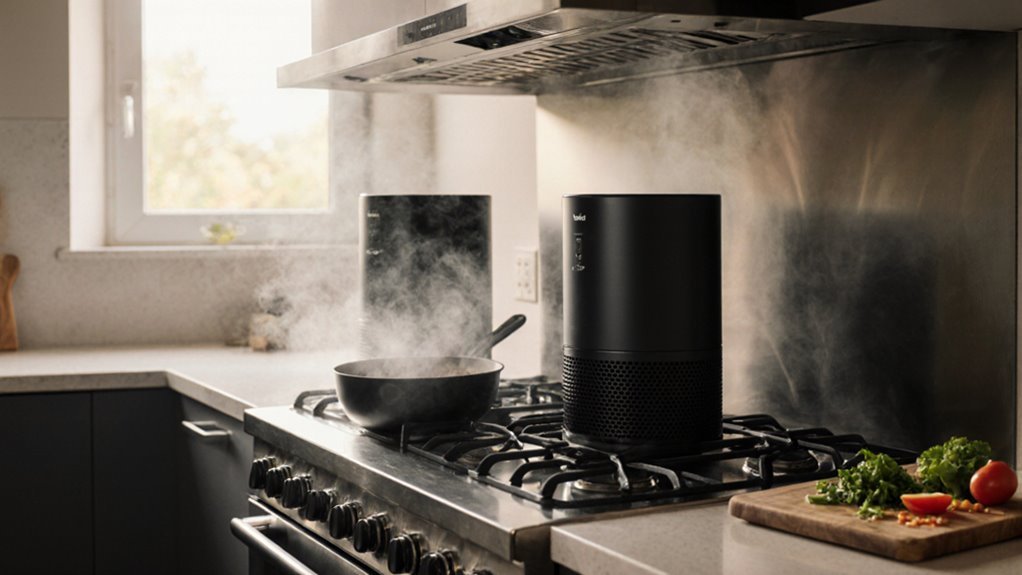

Air purifiers can reduce fine particles, grease smoke, and lingering cooking odors when equipped with True HEPA and activated carbon filters. Placement near the kitchen and running units before, during, and after cooking improves effectiveness. HEPA traps particulate matter; activated carbon adsorbs volatile organic compounds and smells. Some combustion gases and ultrafine particles are harder to remove, so source control and ventilation help. Combining a quality purifier with good ventilation yields the best indoor air after cooking.
What Pollution Cooking Leaves Behind
Cooking leaves a quiet trail behind, even after the pan is off and the kitchen smells normal again. You still breathe in residual pollutants like PM2.5, ultrafine particles, nitrogen dioxide, carbon monoxide, and VOCs.
Frying, grilling, and searing send out more smoke and grease than boiling or steaming, so your air can feel heavier fast. In case you employ a gas stove or cook longer, NO₂ can rise even more.
Then warm air carries those plumes into hallways, bedrooms, and common areas, where indoor deposition lets particles settle on surfaces and remain there. You mightn’t smell anything, but the pollution can still linger.
Even ovens that clean themselves and other combustion appliances can add sudden spikes, so your household deserves care and fresh, clean air.
Why Range Hoods Miss Kitchen Pollution
Even while a range hood is humming above the stove, it doesn’t always catch the pollution that cooking throws into the air.
You could feel covered, but airflow gaps let smoke slip around the edges, and warm currents carry tiny particles past the fan.
Many hoods also rely on recirculation limits, using thin filters that trap some grease and odor yet miss combustion gases and ultrafine particles.
On top of that, you might run the hood low, or skip it, and then NO₂ and soot can spread into nearby rooms.
Even well-fitted units remove heat and steam near the burner, but they don’t always match the burst of pollution from searing or frying.
How Kitchen Air Purifiers Clean the Air
Kitchen air purifiers clean your air with layered filters that catch both the mess you can see and the odors you can still smell.
A washable pre-filter grabs grease and bigger particles, while True HEPA traps tiny smoke bits that slip through most filters.
Then activated carbon helps soak up VOCs and food smells, and smart auto mode can speed things up whenever cooking pollution spikes.
Particle And Odor Capture
A good kitchen air purifier can start cleaning the air the moment smoke begins to drift from your pan. With smart Filter placement near the stove, you help it catch the mess before it spreads through your home.
A true HEPA filter grabs at least 99.97% of tiny smoke, oil, and aerosol particles, so your kitchen feels fresher fast. Then activated carbon works on Odor chemistry, adsorbing grease and smoke smells that cling to the room.
Most units pair these with a washable pre-filter that traps larger bits initially. For best results, run the purifier before you cook, keep it on during the meal, and let it work for 30 minutes after. That way, you and your space stay comfortable together.
Smart Auto Filtration
Smart auto filtration makes kitchen cleanup feel a lot less hands-on, because the purifier can sense what your pan is sending into the air and react right away.
You get predictive sensing that watches PM2.5 and VOC spikes, then ramps up fan speed before smoke and smells settle in. With adaptive scheduling, your unit can keep working during cooking and stay on for at least 30 minutes after, so the air feels fresher whenever you’re done.
For the best results, place it near the stove and choose a size that fits your kitchen or open space. A good model uses a washable pre-filter, True HEPA, and activated carbon to catch grease, fine particles, and odors.
Should you cook often, watch the filter-life light so you can swap parts before performance drops.
Why Activated Carbon Matters After Cooking
After cooking, activated carbon matters because it grabs the odors and gas-like VOCs that still hang in your kitchen, even though the smoke looks gone.
You’ll get the best results whenever your purifier pairs carbon with HEPA, since HEPA catches tiny particles while carbon handles the smell.
Should you cook often, keep the purifier near the stove and replace the carbon sooner, because heavy use can wear it out fast.
Odor Absorption After Cooking
Lingering cooking smells can hang around long after the pan cools, and that’s where activated carbon really earns its keep. You want your kitchen to feel fresh, not trapped in last night’s fry-up. Activated carbon helps by grabbing odor molecules in its tiny pores, so scent chemistry shifts in your favor.
- Multi-layer carbon can hold more smell than thin filters.
- Heavier cooking loads charcoal longevity faster, so replace it sooner.
- Run your purifier near the stove before, during, and after cooking.
That setup works best with a True HEPA filter beside the carbon, since HEPA catches particles while carbon handles gases. In a busy kitchen, fresh carbon every 3 to 6 months helps you keep the air welcoming for everyone.
Capturing Lingering Gas Pollutants
Because cooking does more than leave behind crumbs and steam, you also need to take into account about the gases you can’t see. Activated carbon helps you breathe easier after frying, grilling, or browning because it adsorbs VOCs, aldehydes, sulfur compounds, formaldehyde, and nitrogen dioxide. It does what HEPA can’t: it targets smells and other gas pollutants that hang around and make your kitchen feel stale.
For stronger carbon longevity, choose a purifier with a thick carbon bed or impregnated carbon, since more surface area improves adsorption kinetics and holds up better during busy meals. Place it near the stove, match it to your room size, and let it run for at least 30 minutes after you eat. Since heavy cooking loads use carbon faster, plan for replacement every few months so your space stays welcoming.
Carbon Filters And Kitchens
Cooking fills your home with more than a good smell, and that’s where activated carbon really earns its keep. Whenever you fry, roast, or season heavily, your purifier’s carbon layer catches stubborn VOCs and odors that HEPA alone can’t touch. That means you can breathe easier and feel more at home after dinner.
- Place it near the stove for better contact.
- Run it before, during, and 30 minutes after cooking.
- Watch charcoal maintenance, because filter longevity drops with frequent oil cooking.
For a normal kitchen, choose a model with strong airflow and a thick carbon bed, not just a basic dust catcher. In case you cook often, replace the cartridge every 3 to 6 months.
With the right setup, your kitchen stays welcoming, fresh, and ready for the next meal.
How to Choose a Kitchen Air Purifier
Choose a kitchen air purifier with the job in mind, not just the label on the box. You want True HEPA plus activated carbon, because HEPA grabs fine smoke and carbon helps with odors and VOCs.
Check CADR and coverage so the unit can handle your cooking space, then place it near the stove edge to catch mess promptly. Look for auto mode and real-time sensors, so it speeds up when dinner gets lively and keeps working for 30 minutes afterward.
A simple maintenance schedule matters, too, especially should you share the kitchen often. Washable pre-filters can save time, and you’ll replace carbon more often in this room.
Also, pay attention to noise levels, so the purifier feels like part of your home, not a noisy guest.
Match Purifier Coverage to Kitchen Size
A well-sized purifier can make a smoky kitchen feel calm again, and the right match starts with your floor space. Use coverage mapping to check the unit’s rated area, then do square footage matching before you buy. In case your kitchen opens to the family room, count both spaces together so smoke doesn’t drift into the next room.
- BreatheSmart 25i fits about 400 to 800 sq ft
- BreatheSmart 35i fits about 700 to 1,400 sq ft
- BreatheSmart 45i fits about 950 to 1,900 sq ft
Should you fry or grill often, move up to the next model so you keep up with faster odors and particles. In a small kitchen, choose a full-room rating or a slim model, because an undersized unit works too slowly whenever you need relief most.
Where to Place a Kitchen Air Purifier
Once you’ve matched the purifier to your kitchen size, the next step is putting it where it can actually catch the mess you make while cooking. For the best countertop placement, set it at the edge of the cooking area, about 3 to 6 feet from the stove, and a little downwind. That plume positioning helps the unit grab smoke and greasy mist before they spread into your home.
In case your kitchen opens to the family room, place it between both spaces so it can help your whole crew breathe easier. Keep it off the stove and away from heat, since hot spots can strain the filter. Should space feel tight, use a slim or wall-mountable model near the counter, then keep it on a stable surface.
When to Run Your Kitchen Air Purifier
Turn your kitchen air purifier on a few minutes before you start cooking so it can begin catching smoke and odors ahead of time.
Keep it running during active cooking, then let it work for at least 30 minutes after meal cleanup to clear the last stubborn particles.
Should you be frying, grilling, or cooking over high heat, use a stronger setting until the air feels clean again.
Before Cooking Starts
Give your kitchen air purifier a small head start before the initial pan hits the heat, and it can do a much better job from the start.
For smart preheat timing, turn it on 5 to 10 minutes beforehand so it can build airflow and clear background particles.
Then use this placement strategy:
- Set it 3 to 6 feet from the stove.
- Keep it slightly raised.
- Pick True HEPA plus activated carbon.
You’ll help the unit catch smoke and oil mist before they drift through your home.
Choose high or Auto mode, and match the size to your kitchen, especially in open spaces.
In case you cook often, let it keep going after you start.
Whenever possible, pair it with a range hood or an open window, since that team effort feels like a win.
During Active Cooking
As the pan heats up and the initial sizzle starts, your kitchen air purifier should already be working so it can catch the oil mist and tiny particles that form quickly once you fry or sear.
Turn it on at once, then keep it on high or auto-boost while you cook, since stronger airflow clears smoke and PM2.5 faster.
For best fan placement, set the unit near the cooktop but out of direct heat, like on the edge of the cooking zone or a few feet away.
A True HEPA filter with activated carbon helps trap both fine mess and stubborn odors.
Should noise management matters, choose a setting you can live with so the purifier stays on through the whole meal, helping your home feel fresh and shared space-friendly.
After Meal Cleanup
Once the meal is done, your kitchen air purifier still has work to do, because smoke, grease, and VOCs can hang in the air long after the pan leaves the stove. Keep it on for at least 30 minutes so it can catch leftover particles and odors.
Should you have fried food or cooked with a lot of oil, let it run for 60 minutes or more.
- Place it near the stove, but away from heat.
- Use True HEPA and activated carbon for fine dust and smells.
- Check the washable pre-filter monthly, since stubborn grease builds up fast.
A good cleaning schedule helps your unit stay strong.
In case you cook often, replace carbon filters every 3 to 6 months and HEPA filters every 6 to 12 months.
That way, your kitchen feels fresher, and you belong to the clean-air crew.
Which Cooking Methods Pollute More
Whenever you cook with high heat, some methods pollute far more than others, and that can make your kitchen feel a lot less fresh than you’d like. Oil-based frying, grilling, and searing create more oil aerosols and high heat emissions than boiling or steaming. Should you use gas, your air can also pick up more NO₂, and longer cook times raise PM2.5 too.
| Method | Pollutants | Level |
|---|---|---|
| Frying | PM, oil aerosols | High |
| Grilling | VOCs, odors | High |
| Searing | Fine particles | High |
| Steaming | Few particles | Low |
| Boiling | Few pollutants | Low |
Lower heat, shorter cook times, and water-based methods help you keep your space more comfortable. Whenever you choose gentler cooking, you give your home a cleaner, calmer feel.
How Food Type and Temperature Affect Pollution
Higher heat doesn’t just change how food tastes; it also changes what floats into your air, and that can matter a lot while you’re trying to keep your kitchen comfortable. Once you push past key temperature thresholds, you raise smoke, VOCs, and tiny particles.
- Frying and grilling usually send out more pollution than steaming.
- Fat composition matters because oily foods release more droplets and ultrafine particles.
- Some oils, including olive oil, can give off more particles at high heat.
Longer cooking also builds more nitrogen dioxide, especially on gas stoves. So you can help your space feel better by choosing lower heat, water-based methods, and oils with higher smoke points. That way, you protect the air you share with everyone at home.
Do Air Purifiers Work in Kitchens?
Yes, air purifiers can help in kitchens, especially while cooking fills the room with smoke, grease, and strong smells. You’ll breathe easier whenever a True HEPA model catches fine particles, and activated carbon helps trap odors and many cooking fumes. | Feature | What It Does | Kitchen Benefit |
| — | — | — |
|---|---|---|
| True HEPA | Traps tiny particles | Cleaner air |
| Carbon layer | Absorbs odors | Less lingering smell |
| Smart sensors | Track smoke spikes | Faster response |
| Maintenance scheduling | Reminds you at the time | Better performance |
| Sensor calibration | Keeps readings accurate | Smarter auto mode |
Pick a unit sized for your open space, and set it near the stove so it grabs pollution before it spreads. You’ll still want normal kitchen airflow, but the purifier can make your space feel calmer, fresher, and more welcoming after dinner.
Can a Kitchen Air Purifier Replace a Hood?
A kitchen air purifier can make a big difference, but it can’t fully replace a hood.
Whenever you cook, a purifier with True HEPA and activated carbon can catch fine particles, smoke, and smells, so your space feels fresher fast. But it can’t pull heat, steam, grease, or combustion gases away at the stove. That’s why vented hoods still matter for source control and shared comfort.
- Use ductless alternatives if outdoor venting isn’t possible.
- Pick a purifier sized for your kitchen or open-plan space.
- Run it before, during, and after cooking.
If you live with frequent frying or gas use, pair both whenever you can. That mix supports better aesthetic integration and helps your kitchen feel cleaner, calmer, and more welcoming for everyone.
Which Features Matter Most in a Kitchen Purifier?
Anytime you shop for a kitchen purifier, the most vital features are the ones that help it keep up with real cooking mess, not just everyday dust.
You’ll want a True HEPA filter for fine smoke, plus activated carbon to tackle odors and VOCs. Size matters too, so pick one that fits your kitchen or open-plan space and can move enough air fast.
Auto mode with real-time sensors helps it react whenever you’re frying or searing. Check filter lifespan, because kitchen use can wear carbon down quickly, and watch noise levels so you’ll actually keep it running.
A washable pre-filter or grease-resistant design also helps. For best results, place it near the cooktop, then run it before, during, and after cooking.
Frequently Asked Questions
Does an Air Purifier Help With Smell After Cooking?
Yes, an air purifier helps, but you’ll want one with HEPA effectiveness and activated carbon for real odor neutralization. It will cut smoke and lingering cooking smells fast, especially if you run it during and after cooking.