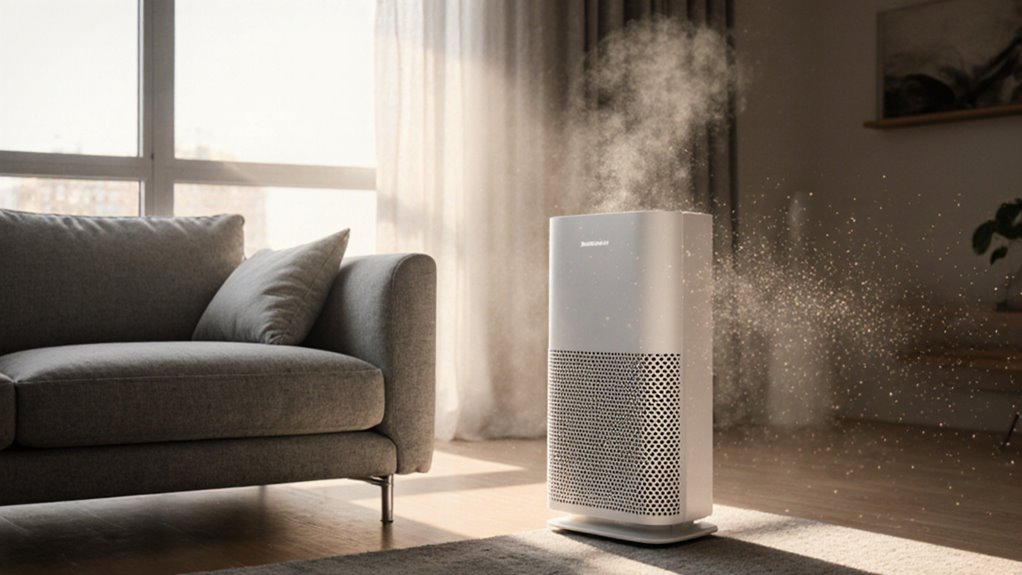

Yes — air purifiers reduce airborne contaminants when chosen and used correctly. True HEPA filters trap fine dust, pollen, smoke, and many particles that carry germs. Activated carbon filters absorb many odors and some volatile organic compounds. Room size, purifier capacity, placement, and runtime determine actual performance. Small, smart choices in model and operation deliver noticeably cleaner, fresher indoor air.
What Air Purifiers Remove
Air cleaning works best once you know what it can actually catch. You can rely on true HEPA filters and upgraded HVAC filters to trap fine particles like PM2.5, smoke, dust, pollen, mold spores, and many virus-laden aerosols whenever the unit fits your room. That means you’re not just breathing easier, you’re helping your space feel more like everyone belongs.
A good purifier also cuts some gases and odors with activated carbon, though those stages wear out sooner, so watch filter lifespan. Also, noise levels matter, because a quieter unit is easier to keep running. Keep in mind, some devices can make ozone or other unwanted byproducts, so choose zero-ozone models. Clean air builds over time, but it doesn’t replace ventilation, masking, or hygiene.
How HEPA Filters Work
Whenever you use a true HEPA filter, you’re getting a mechanical trap that captures at least 99.97% of particles at 0.3 micrometers, which is the hardest size to catch.
It works through interception, impaction, and diffusion, so it can still grab bigger particles and even tiny virus-laden aerosols with strong efficiency.
Just keep in mind that your purifier also needs enough airflow for your room, because great filtration only helps provided air keeps moving through the filter.
HEPA Capture Mechanisms
HEPA filters work through quietly trapping tiny particles in a dense mat of fibers, and that’s what makes them so reassuring in real life. You get protection from three capture moves.
First, bigger bits crash into fibers by impaction. Next, mid sized particles drift close and stick by interception. Then the tiniest ones wobble in air and hit fibers by diffusion. This mix helps you even when particle size shifts.
The 0.3 micrometer mark matters because it’s the hardest trial, yet your filter often does better above and below it. Fiber charging can add help, but the core job stays mechanical. Even as media aging happens, good airflow and a snug fit keep your purifier working for you and your space.
Particle Filtration Efficiency
Precision matters here, because a true HEPA filter does its best work via quietly catching particles you can’t see. You get strong protection whenever the filter traps at least 99.97% of 0.3 micrometer particles, the tough exam size. Bigger particles usually stick alongside interception and impaction, while smaller ones drift into the filter through diffusion, so performance can stay just as strong on either side of that benchmark.
That matters for virus-containing aerosols in the 0.1 to 1 micrometer range, which high-quality H13 units handle well. Still, you need more than a good filter. You also need enough airflow, a snug seal, and little air bypass. As filter aging sets in, particle deposition changes, so check fit and replace worn filters promptly.
Do Air Purifiers Reduce Viruses?
Yes, air purifiers can reduce viruses in the air, especially while they use true HEPA filtration and you size them correctly for the room. Whenever you breathe, speak, or cough, tiny aerosols can linger, and that airborne persistence gives germs time to move. A well-run purifier helps you lower that load. | Benefit | What you notice | Why it helps |
| — | — | — |
|---|---|---|
| HEPA capture | Cleaner room air | Removes many virus-carrying particles |
| Steady use | Faster drop in risk | Keeps air moving through the filter |
| Smart placement | Better coverage | Reaches the space you share |
That’s where mask interaction matters too. You’re not doing this alone; the purifier works best with masks, distance, and good habits. Keep it running in occupied rooms, and you give yourself a calmer, safer indoor space.
How to Choose the Right Size
To pick the right purifier, you need to match its CADR to your room size, not just trust the box label.
A good rule is to aim for 4 to 6 air changes per hour in most rooms, and more in shared or higher-risk spaces, so the unit can actually keep up.
In case a brand lists square-foot coverage, choose a model rated for a bigger room so it can run quieter while still cleaning the air well.
Room Size Matching
A purifier only helps provided it fits the room, and that part can feel tricky initially, but it gets much easier once you look at the room’s actual size. You want portable sizing that matches your space, not a guess from a box. Should the maker gives square feet, check the ceiling height initially. Then compare the room volume to the unit’s rating. For bedrooms and other close spaces, aim a little higher so you and your people get steadier relief.
- Measure length, width, and height.
- Use actual room volume, not a big promise.
- Size up whenever you’re unsure.
- Split the load with two units if required.
That approach also supports ventilation integration, because the purifier can work with your room’s airflow instead of fighting it.
CADR And Coverage
Clean air starts with the number that matters most: CADR. You want a purifier that matches your room volume, so the air turns over 4 to 6 times each hour.
Use the room area, ceiling height, and desired ACH to estimate the CADR you need. Should you choose a unit rated for a larger space, it can often run with less fan noise while still giving you strong cleanup. That helps you feel settled, not stuck with a loud machine.
Look for HEPA or smoke-rated models whenever you care about tiny particles like viruses and smoke. Also, check room placement, because good airflow matters.
In the event one unit can’t cover the whole space, two smaller purifiers can work together and spread clean air more evenly.
Where to Place an Air Purifier
Whenever you choose where to put an air purifier, the room matters just as much as the machine itself. For ideal placement, start in the room you use most, like your bedroom or family room. Then keep airflow direction in mind so the unit can help your whole space.
- Set it near the center or main activity area.
- Leave the intake and outflow open.
- Don’t hide it in a closet or behind furniture.
- Aim it so cleaned air doesn’t blow from one person to another.
If you need source control, place it near the person who needs extra protection, like beside a bed.
In bigger rooms, you might need more than one unit to reach strong air changes. That way, you can breathe easier together.
How to Use Air Purifiers for Best Results
To get the most from your air purifier, start choosing a HEPA-designated or CADR-rated model that fits your room size, because an underpowered unit can leave too many particles behind. Aim for about 4 to 6 air changes per hour, and use the maker’s room-size guidance so the cleaner works with your space, not against it.
Then place it where you gather most, on an open surface away from walls, curtains, or closets, so airflow stays strong and steady. Keep it running while the room’s occupied, and raise the fan speed during busy moments or whenever the room sits empty.
For best results, build maintenance scheduling into your routine, and replace filters on time. With ventilation integration, you’ll keep fresh air moving and feel more at ease together.
DIY Air Cleaners, Safety, and Limits
Provided you like a do-it-yourself fix, a box-fan air cleaner can be a smart short-term helper, but it has clear limits.
You can build one that rivals store models whenever you use a recent UL or ETL box fan and true HVAC filters. EPA still says it shouldn’t replace certified units for long. For DIY safety, match the filter to the fan, seal the edges with duct tape, and add a shroud so air goes through the center.
- Pick higher-MERV or HEPA-designated filters
- Use two to five filters whenever you want more clean air
- Run it faster for better air changes, even whenever noise climbs
- Handle dirty filters with gloves, an N95, and goggles during Filter disposal
Don’t leave older fans running alone or whilst you sleep.
Frequently Asked Questions
How Often Should Air Purifier Filters Be Replaced?
You should replace your air purifier filter every 6 to 12 months, depending on usage frequency and manufacturer recommendations. Watch replacement indicators and shorter filter lifespan from heavy use, so your home team stays breathing easier together.
Do Air Purifiers Increase Electricity Bills Significantly?
Usually you will not see a huge jump: many air purifiers use about 50 watts, so your energy consumption stays modest. You can join the clean air crowd without fearing major operating cost increases.
Can Air Purifiers Help With Pet Odors?
Yes, you can reduce pet odors with an air purifier that offers odor control and scent neutralization. It will also help reduce allergens by trapping pet dander, so your home feels fresher and more welcoming.
Are Air Purifiers Noisy During Regular Operation?
They’re usually quiet at low settings; you may hear gentle fan noise, which can create sound masking. Like a whisper in your space, your purifier can blend in, so you feel comfortable and belong.
Can Multiple Small Purifiers Outperform One Large Unit?
Yes, you can find multiple units that outperform one large purifier provided they improve room coverage and reduce dead zones. You will need to watch filter stacking, noise impact, and proper placement to keep your space comfortable together.