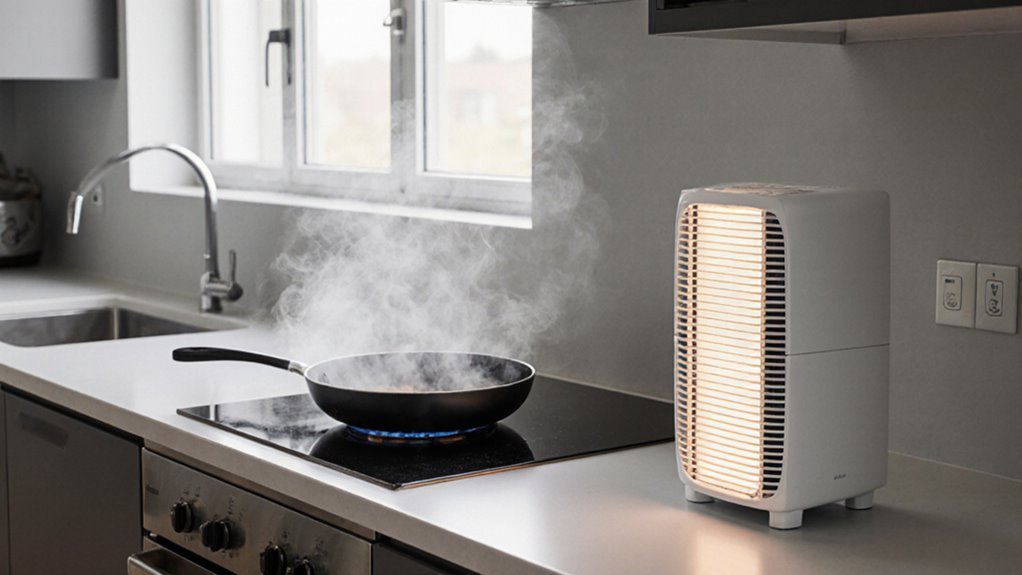

Yes — a proper air purifier can reduce kitchen smoke. True HEPA filters capture most tiny smoke particles. Activated carbon filters absorb many cooking odors and some gaseous compounds. Placement and unit size determine actual effectiveness. Running the purifier before and during cooking improves results.
Can Air Purifiers Remove Kitchen Smoke?
Yes, air purifiers can remove kitchen smoke, and that can feel like a huge relief once your pan starts smoking and the whole room suddenly smells like dinner chaos.
You’re not imagining it. A true HEPA filter grabs at least 99.97% of tiny smoke particles, so it can help whenever frying or grilling kicks up a cloud. For best results, choose a purifier with strong CADR for your room size, and place it 6 to 10 feet from the stove. Start it before you cook, and keep it running after dinner too. Activated carbon also helps with odors. It works best whenever you keep the unit moving air around cooking steam and thermal plumes.
Paired with a venting hood, it makes your kitchen feel calmer fast.
What Kitchen Pollutants Can They Catch?
You’ll find that kitchen air cleaners can catch two big troublemakers: fine smoke particles and the tiny bits that come from frying or grilling.
With a true HEPA filter, they trap those particles, and with activated carbon, they also help cut down stubborn cooking smells and many gas pollutants. Still, they can’t handle every gas in the air, so ventilation matters too.
Smoke And Fine Particles
Kitchen smoke is mostly made of tiny particles, and that’s where a good air purifier can really help. You can consider particle behavior as the way those bits move and linger.
A true HEPA filter catches at least 99.97% of particles down to 0.3 microns, so it can trap the fine smoke from frying and grilling before it settles into your space. It also offers strong ultrafine capture for particles from overheated oils and non-stick pans.
Should you want faster cleanup, check smoke CADR, because higher numbers clear air quicker. In a typical kitchen-sized room, units like the Levoit Core 300S and Shark HP102 can handle heavy smoke in about 32 to 38 minutes. Run yours during cooking, then keep it going after.
Odors And Gas Pollutants
While smoke particles get most of the attention, the smells and gases from cooking can linger just as long, and that’s where the right purifier starts to feel like a relief. You need a purifier with pellet or honeycomb carbon, because activated carbon adsorbs VOCs and odor molecules that HEPA can’t catch. HEPA still helps by trapping tiny smoke particles that carry smell, so your kitchen feels fresher faster.
But heavy frying can push charcoal saturation quickly, especially whenever grease and fumes fill the air. That’s why larger carbon loads matter. Also, nitrogen dioxide and carbon monoxide need strong carbon or source ventilation, plus a detector for safety.
Check sensor calibration, run the unit before, during, and after cooking, and you’ll give your home a calmer, more welcoming feel.
Why HEPA and Activated Carbon Matter
HEPA and activated carbon do two very different jobs, and that matters a lot as cooking sends smoke into the air.
With HEPA mechanics, you get fine particle capture. A True HEPA filter traps at least 99.97% of particles down to 0.3 microns, so it catches much of the smoke and grease that can reach deep into your lungs. Then Carbon adsorption steps in for gases. Activated carbon holds VOCs and stubborn odors in its porous surface, which keeps your kitchen from smelling like last night’s stir fry forever.
Because kitchen use fills carbon fast, you’ll usually replace it every 3 to 6 months. Whenever you choose both filters together, you give your home a cleaner, calmer feel and make cooking more comfortable.
How Big Should Your Kitchen Air Purifier Be?
Size your purifier to your kitchen, not just to the corner where you plan to park it. You want enough power to match your room volume and your cooking habits. For normal meals, aim for at least 4 ACH. Should you bake, can, or stir up lots of smoke, look for 8 ACH or even 10 to 12 ACH. Use the CADR rating to check the match: the unit’s CFM should fit your kitchen volume.
In open-plan homes, include nearby household space so odors don’t wander off and settle in with the family. A larger unit can help, but noise levels matter too, so choose one you can tolerate. Set it 6 to 10 feet from the stove and run it before cooking.
Best Kitchen Air Purifiers We Tested
You’ve got a few strong kitchen air purifiers to choose from, and the best one for you depends on your space and how much smoke you deal with.
For a budget-friendly pick, the Levoit Core 300S cleaned our trial room fast, while the Shark HP102 worked well for smaller kitchens with less airflow.
In case you cook in a larger kitchen or open layout, the Alen BreatheSmart 45i gives you the extra power you need to handle smoke and odors more easily.
Top Kitchen Picks
Among our kitchen-examined air purifiers, the Levoit Core 300S stood out as the fastest smoke clearer in our 728 cu ft trial lab, finishing in 32 minutes, while the earlier Core 300 took 45 minutes. You can feel confident with the Alen BreatheSmart 45i for open kitchens, and the Shark HP102 for smart, hands-off cleanup.
| Pick | Why it helps you |
|---|---|
| Levoit Core 300S | Quick smoke removal |
| Alen BreatheSmart 45i | Strongest airflow |
| Shark HP102 | Smart Auto Mode |
| Shared build | HEPA and carbon |
Together, these picks fit real cooking life. Use pre cook strategies, then start the purifier before heat hits the pan. Run it high during frying, and keep it on after dinner. Follow maintenance schedules closely, because grease can clog filters fast. That way, you stay in the clean-air crowd.
Budget-Friendly Options
Provided that you want cleaner kitchen air without spending a fortune, this is where the smart picks really start to shine.
The Levoit Core 300S gives you fast smoke clearing in small-to-medium spaces, and its true HEPA plus carbon setup handles both fine particles and odors well. Should you want a counter-size option, the Shark HP102 costs less and still cleaned our trial room in 38 minutes, so you’re not giving up much.
For tougher cooking, a pricier model like the Alen BreatheSmart 45i works faster, but it’s less budget friendly. No matter which one you choose, look for Auto Mode, check filter maintenance often, and pay attention to noise levels so your kitchen still feels calm while dinner sizzles.
Large Kitchen Choice
For large kitchens and open-plan spaces, the Alen BreatheSmart 45i stands out as our top evaluated pick because it cleared a 728 cu ft trial room in 34 minutes and reaches up to 301 sq. ft., which makes it a strong match whenever cooking smoke likes to wander.
You can lean on its True HEPA H13 filter and strong carbon stage to catch smoke and odors before they drift into your household room.
To size it right, aim for at least 4 ACH, and go higher should you fry often.
Place it 6 to 10 feet from the stove, then use smart controls to raise speed during cooking and afterwards.
With ventilation integration, you can support your range hood too.
Just expect faster filter wear in kitchens.
Where Should You Place and Run It?
Place your purifier where it can catch smoke before it spreads, not after the room already feels hazy. Use countertop placement or a top-cabinet spot 6 to 10 feet from the stove, and keep the airflow direction aimed toward the cooking path.
In an open kitchen, set it between the stove and the rest of your home, so your crew breathes easier together.
- Start it prior to you turn on heat, and again once the oven preheats.
- Run higher speed for frying or grilling, then let it work 30 minutes after.
- Match the unit to your room, and never block the vents.
Once you place it well, you help your kitchen feel calmer, cleaner, and more like a shared space.
Frequently Asked Questions
Do Air Purifiers Work for Cooking Smoke?
Yes, they do. Like a shared kitchen after Friday tacos, your air feels fresher fast whenever you use HEPA filtration and Activated carbon; you will catch smoke particles and odors, especially with proper sizing and airflow.