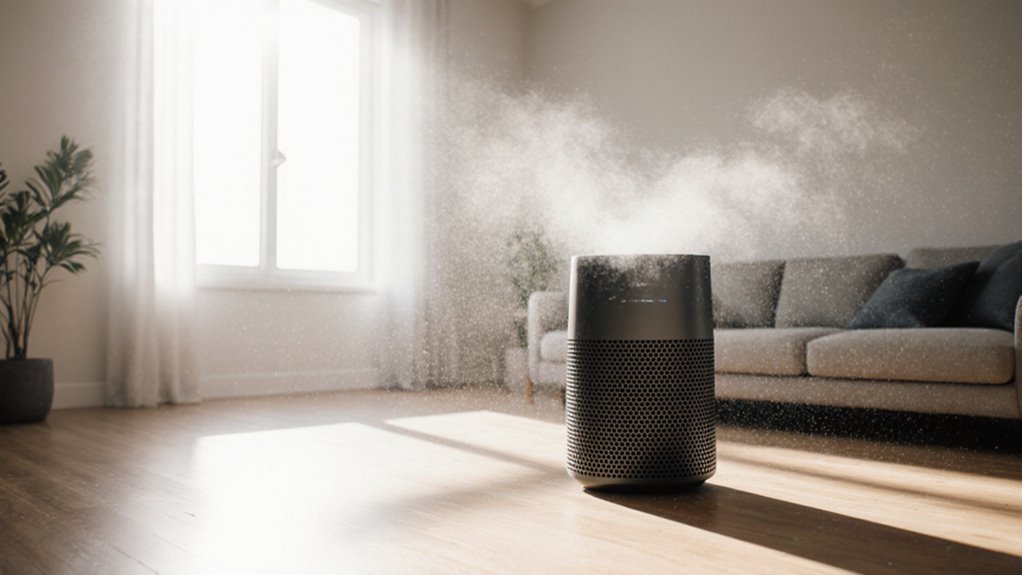

Clean Air Delivery Rate (CADR) measures how much filtered air an air purifier delivers for smoke, dust, and pollen. It combines airflow and filter efficiency into a single number that shows real-world cleaning performance. Higher CADR means a purifier cleans a room faster and handles larger spaces. Comparing CADR values helps pick a unit that matches room size and pollution type. That makes choosing an effective air purifier straightforward and based on measurable performance.
What Is Clean Air Delivery Rate?
Clean air delivery rate, or CADR, tells you how much cleaned air a portable air cleaner can give back to a room each minute. You can use it to judge how well a unit might help with health impacts from indoor particles, especially whenever you want air that feels safer to share.
CADR measures particulate removal only, not gases or VOCs, and it follows regulatory standards for a fresh filter in an examination room. You’ll see separate ratings for smoke, dust, and pollen, since each particle type behaves differently.
A higher CADR usually means stronger cleaning, but fan airflow and filter efficiency both matter. Should a filter clog or the speed drops, the rating can fall, so you’ll want a unit that fits your space and gives your household steady support.
How Is CADR Measured?
You can consider of CADR testing as a careful room experiment, where the purifier sits in a standardized 1,008-cubic-foot chamber and the air gets mixed on purpose.
Then you measure how fast smoke, dust, and pollen particles fade with the unit on, compared with natural settling alone.
From there, you get three ratings, one each for smoke, dust, and pollen, so you can see how the purifier handles different particle sizes.
CADR Test Room Setup
Inside a sealed 1,008-cubic-foot trial chamber, CADR takes shape in a very controlled way, so the numbers stay fair and easy to compare. You’ll find the purifier set in the center, while the test chamber stays quiet except for a wall fan that helps circulation uniformity. Before the run starts, a ceiling fan is switched off, and standardized particles fill the room.
- Smoke assessments use tiny particles.
- Dust evaluations use mid-size particles.
- Pollen examinations use larger particles.
- A single sensor tracks counts during each run.
Then the purifier works at max speed, and the chamber shows how fast the air clears. Because the setup stays consistent, you can trust the result for smoke, dust, and pollen in your own search for cleaner air.
Particle Decay Measurement
To measure CADR, examiners watch how fast particles disappear in a sealed 1,008-cubic-foot chamber, and they compare that change with and without the purifier running. You see your purifier at max speed, while one circulating fan keeps the air mixed. Initially, evaluators add a known particle cloud, then they track particle lifetime over about 20 minutes. Decay modeling shows how quickly counts fall from natural settling versus the cleaner’s extra pull.
| Check | What it shows |
|---|---|
| Natural decay | Chamber losses alone |
| Cleaned decay | Purifier effect |
| Difference | CADR result |
| Airflow x removal | Final rating |
Because the device’s airflow and removal fraction both matter, you get a score that reflects real cleanup power. You’ll usually see separate ratings for different particle sizes, so you know where you belong.
Smoke Dust Pollen Ratings
CADR does more than give you one air-cleaning number, because it breaks performance into three useful ratings: Smoke, Dust, and Pollen. You can read them like this:
- Smoke measures tiny particles from 0.09 to 1.0 μm.
- Dust covers 0.5 to 3 μm.
- Pollen covers 5 to 11 μm.
- Each rating shows clean air volume in CFM for that particle type.
Labs evaluate a purifier in a sealed 1,008-ft³ room and compare particle decay against natural decay.
Then they turn removal rate into CADR. Since CADR equals particle removal fraction times airflow, stronger flow or better filtration lifts the score.
In real world use, dust and pollen often score lower because they settle faster, and filter aging can trim results. AHAM Verifide evaluation helps you compare with confidence.
What Do Smoke, Dust, and Pollen CADRs Mean?
Smoke, dust, and pollen CADRs each tell whether a purifier can clear a different kind of particle from the air, and that difference matters more than most people consider.
You’re looking at three ratings in CFM, and each one fits a different particle size. Smoke CADR covers tiny combustion and wildfire particles, so it usually matters most for fine health risks. Dust CADR tracks mid-sized bits, and it reflects both filter efficiency and how those particles settle in the evaluation. Pollen CADR measures larger grains and some spores, so it can rise or fall compared with smoke.
Since the numbers come from a new filter in a trial chamber, real results can shift assuming you use non-genuine filters or alter fan speed.
Why Does CADR Matter for Air Quality?
A good CADR number can make the difference between air that just moves around and air that actually feels cleaner. Once you pick a purifier, you’re not guessing; you’re choosing how quickly it can lower health impacts from smoke, dust, and pollen. A stronger CADR helps source control by pulling particles out faster before they settle into your space.
- It matches room size better, so the purifier can keep up.
- It blends filter power and airflow, not just one or the other.
- It shows you what happens at full speed, which matters.
- It helps you compare models with less confusion.
That said, your real result can shift with layout, filter wear, and fan setting. Still, a solid CADR helps you feel part of a cleaner home.
What Is AHAM Verifide?
AHAM Verifide means you’re looking at a portable air cleaner that’s been examined in an accredited lab, so the CADR claims aren’t just guesses.
It also checks that replacement filters and alternate setups still perform like the original unit, which helps you trust what you’re buying.
Once you see the AHAM Verifide seal, you can feel more confident that the cleaner’s smoke, dust, and pollen ratings have been independently validated.
AHAM Verifide Testing
Upon seeing the AHAM Verifide mark, it helps take the guesswork out of shopping for an air cleaner. You get third party testing and lab accreditation you can trust, so you feel like you belong in a smarter crowd of buyers. AHAM evaluates portable room cleaners to the ANSI/AHAM AC-1 standard in a set 1,008 cubic foot room, then measures CADR for smoke, dust, and pollen. That means you can compare claims with confidence.
- Smoke gets checked for tiny particles.
- Dust shows everyday cleanup power.
- Pollen helps you judge allergy relief.
- Reports explain room-size claims clearly.
Because retailers, the EPA, and the FTC recognize the seal, you can shop with less stress and more certainty.
Verified Filter Performance
Provided that you’re already comparing CADR numbers, the next thing to check is whether the filter inside the unit can keep that performance steady over time. AHAM Verifide gives you that extra confidence. It uses independent evaluation in accredited labs to see whether a replacement filter matches the original unit’s airflow and particle removal, including smoke, dust, and pollen. That means you’re not guessing about verified efficiency; you’re checking proof that the filter still works like it should.
| Check | What it means |
|---|---|
| Third-party review | AHAM verifies the claim |
| Lab method | ANSI/AHAM AC-1 |
| Particles evaluated | Smoke, dust, pollen |
| Result | Matches OEM performance |
| Benefit | You keep trusted CADR |
When you choose a marked filter, you join a group that wants clear facts and better air.
Trusted Performance Seal
Consider the AHAM Verifide seal as a quick trust check for your air cleaner. It tells you the unit has passed third-party trials in an accredited lab, so you can feel stronger consumer trust whenever you shop. AHAM measures CADR for smoke, dust, and pollen in a controlled chamber, then compares active cleaning with natural settling. That helps you see real performance, not just promises.
- The seal confirms evaluated airflow.
- It shows seal recognition from retailers and agencies.
- It covers replacement filters too.
- It helps you avoid weak off-brand parts.
How Does Room Size Affect CADR?
Room size sets the pace for how well a purifier can clean the air, because a small unit in a big room can only do so much before it falls behind. You want CADR that matches your space, so use the floor area as your guide.
A good rule says CADR should reach about two-thirds of the room’s square feet, and wildfire smoke needs even more, closer to one CFM per square foot. Should your ceiling runs higher than 8 feet, you’ll need more power to keep up.
Also, occupancy adjustments and furniture layout can affect how air moves around you. Whenever one purifier can’t meet the target, choose two or more units whose combined CADR gets there. That way, your room feels cleaner, calmer, and easier to share.
How Do You Use the 2/3 Rule?
To use the 2/3 rule, measure your room’s floor area by multiplying length by width in feet, then find a smoke CADR that’s at least two-thirds of that number.
For example, a 12 by 20 foot room is 240 square feet, so you’d want a smoke CADR of at least 160 CFM.
Should your room has a taller ceiling or one unit can’t quite keep up, select a higher-rated model or combine units so their total CADR meets the target.
Room Size Calculation
A simple way to size a purifier is to start with your room’s floor area and then use the 2/3 rule, which gives you a quick smoke CADR target that actually makes sense.
Initially, measure length times width, then aim for a smoke CADR at least two-thirds of that number. For example, a 12 by 20 room gives you 240 square feet, so you’d look for 160 CFM.
- Check the room area.
- Apply the 2/3 rule.
- Make ceiling adjustments whenever your ceiling is taller than 8 feet.
- Add units together whenever one purifier can’t carry the load.
This helps you match occupancy effects too, since more people can stir up more particles.
In case you want extra protection, you can size even higher.
Smoke CADR Rule
As you use the 2/3 rule for smoke CADR, start locating your room’s floor area in square feet, then multiply that number by two-thirds to get a fast, practical target. For a 10 by 12 room, you’d aim for about 80 CFM. This rule assumes an 8-foot ceiling and a new filter at max speed. Should your ceiling be higher, or outside air leaks in, choose a stronger unit.
For wildfire preparedness, AHAM suggests matching the room’s full square footage for better protection. That gives you extra margin whenever smoke lingers and occupant behavior changes, such as opening doors or moving around often. A higher CADR can clear particles faster, so you can run the purifier quieter and still feel safer in your space.
What CADR Do You Need for Your Room?
Figuring out the right CADR for your room can feel tricky at initially, but you can make it simple with a good rule of thumb. Start with your floor area, then adjust for your space and habits:
- Pick smoke CADR at about two-thirds of the room’s square feet.
- Add a ceiling adjustment if your ceiling is above 8 feet.
- Consider portable placement and occupancy impact, since a crowded room needs more support.
- Choose a bit extra so you can enjoy the noise tradeoff and keep the fan gentler.
For a 12 by 20 room, about 160 CFM works well. For wildfire smoke, you might want the full room area in CADR. Should you want quicker cleanup, size closer to the room’s volume, not just the floor.
Why Does Higher CADR Clean Faster?
A higher CADR means your purifier sends more clean air into the room each minute, so it can pull particles out faster.
Because CADR blends airflow and filter efficiency, a stronger rating can cut smoke, dust, or pollen more quickly, especially while the room isn’t too large for the unit.
In bigger rooms, you’ll usually notice the speed gap even more, since more CADR gives you more air changes per hour.
Higher Airflow, Faster Cleaning
Higher CADR cleans the air faster because it moves more clean air through the room every minute. You feel that difference whenever your space starts to clear and stay comfortable. CADR blends airflow and filter power, so a high-efficiency filter can do more with less CFM.
- More airflow means more room volume gets treated each minute.
- Higher ACH helps particles leave the air sooner.
- A HEPA unit can reach strong CADR with lower fan speed.
- That can ease noise tradeoffs and support thermal comfort.
AHAM suggests a smoke CADR near two-thirds of your floor area, and that target gets easier to hit as CADR rises. Even so, real rooms vary, so mixing, clogging, and fan settings shape how quickly you notice cleaner air.
More CADR, Quicker Removal
CADR tells you how much air a purifier can clean each minute, so more CADR usually means faster cleanup in your room. Whenever you choose a higher CADR, you get rapid removal because more polluted air passes through the filter every minute.
That means the purifier can lower smoke, dust, and other particles sooner, even though the fan and filter work together in different ways. Suppose two units fit your space, the one with the higher certified CADR reaches peak performance faster and can cut the dirty air level sooner.
In practice, that can feel like a better match for your home, since you want the air to clear without waiting around. So, whenever you compare models, higher CADR often gives you the quickest path to cleaner air.
Room Size Matters
As you match the purifier to your room size, the reason for faster cleaning starts to make sense. CADR tells you how much clean air moves each minute, so a higher number can clear particles faster and help you feel at ease in your space.
- A bigger CADR increases air changes per hour.
- In a room with more cubic feet, you need more airflow.
- AHAM says aim for about 0.67 times the floor area in smoke CADR.
- Higher ceilings, busy occupancy density, and furniture layout all ask for more CADR.
How Do Filters Affect CADR Performance?
Filters shape CADR because they control both how much air moves through the purifier and how many particles the filter catches. When you choose a high-efficiency filter, like HEPA, you can get strong smoke removal even with less fan power. A lower-efficiency filter might need more airflow to match that result, so your machine has to work harder.
As the filter fills with dust, filter lifespan matters because airflow drops and CADR can fall from the rated number. That’s why real world performance can feel different from the box. Particle size also changes results, and you could see higher CADR for pollen or dust than for smoke. Should you use off-brand replacements, you can lose capture and airflow, which can hurt your clean-air comfort.
How Do Airflow and Efficiency Shape CADR?
Airflow and filter efficiency work together to decide how much clean air your purifier actually delivers. You belong in the know when you see that CADR comes from both parts, not one alone. A HEPA filter can trap about 99.97% of smoke particles, yet it still needs enough fan flow to move that clean air into your room.
- High efficiency can enhance CADR fast.
- Strong airflow can lift a moderate filter’s result.
- Clogged filters cut flow, so CADR slips.
- airflow optimization helps you balance performance and efficiency tradeoffs.
For smoke-sized particles, a MERV 14 filter might reach about 0.80 times the fan flow. So a 100 CFM fan can deliver near 80 CADR. That’s why your best match feels like a team, not a gamble.
What CADR Limits Should You Watch For?
Now that you know CADR comes from both airflow and filter efficiency, the next question is how much CADR you actually need. For most rooms, look for a Smoke CADR that’s at least two-thirds of the floor area in square feet. So a 120 square foot room needs about 80 CFM.
In the event wildfire smoke is a concern, AHAM’s regulatory guidance says to aim for a Smoke CADR that matches the room size. Also check the smoke, dust, and pollen ratings, because smoke CADR matters most for tiny particles and health.
Keep in mind, ratings come from a new filter at max fan speed, so real use can fall short. Choosing a higher CADR gives you more safety thresholds, quieter operation, and faster cleanup.
How Does CADR Help You Compare Purifiers?
How do you compare air purifiers without getting lost in brand claims? You can lean on CADR because it gives you one plain number for filtered air, so shopping feels less lonely. It shows smoke, dust, and pollen performance in CFM, which makes side by side checks easier.
- Look for AHAM Verifide ratings.
- Compare smoke CADR initially.
- Notice filter type and fan flow.
- Recall real world testing and user perceptions can differ from chamber results.
A purifier with a strong CADR often blends good filter efficiency with solid airflow. Since tests use max speed, you might want a higher number than the minimum. That way, you compare units with more confidence and pick a model that fits your room and your peace of mind.
How Do You Choose the Right CADR?
To pick the right CADR, start with your room size and let the number do the heavy lifting. For a 240 square foot room, a smoke CADR of at least 160 CFM fits the 2/3 rule. Should wildfire smoke be a worry, aim closer to 240 CFM so you and your people feel safer. Check AHAM Verifide labels for smoke, dust, and pollen, because those ratings follow ANSI/AHAM AC-1, not sales hype.
Then match the unit to your space, too. Taller ceilings, open doors, or steady pollution sources call for more CADR, or even two units. Leave some headroom, and you can run lower fan speeds, keep noise levels friendlier, and use a smart placement strategy that helps clean air reach everyone.
Frequently Asked Questions
What Is a Good CADR Value?
A good CADR matches your room: aim for at least two thirds of the square footage, or one to one for smoke. You’ll enjoy cleaner, quieter comfort, longer filter lifespan, and lower noise levels with a little extra margin.
What Is the Difference Between CADR and ACH?
CADR tells you how much clean air your purifier makes, while ACH shows how often your room air gets cleaned. CADR helps you compare devices; ACH helps you judge room performance, filter lifespan, and noise levels.
What Is a 245 CADR Rating?
You’re seeing 245 CFM of clean air, 245 CFM of smoke removal, and 245 CFM of protection. That HEPA efficiency can suit about 368 sq ft, while filter lifespan and fan speed can lower real world performance.
What Is the Clean Air Delivery Rate (Cadr) of AP 500 Smart?
The AP 500 Smart’s CADR is 500 CFM for smoke, 450 CFM for pollen, and 470 CFM for dust. You will get the best results with filter maintenance, and noise levels stay manageable at higher speeds.